Horizon Europe · Grant N° 101156771
Optimal methods to characterize ADC resistance
in solid tumors and identify clinically useful biomarkers
An innovative European research consortium dedicated to the optimization of Antibody-Drug Conjugates (ADCs) therapies to improve the care of patients with cancer.

Partners
Budget
Expected patients
2025-2029
Duration
About OASIS
Understanding and overcoming resistance to antibody-drug conjugates (ADCs)
OASIS is a European research project dedicated to addressing one of today's key challenges in oncology: understanding and overcoming resistance to antibody-drug conjugates (ADCs).
ADCs are a new generation of cancer therapies designed to deliver powerful anticancer drugs to tumor cells, while limiting damage to healthy tissues. Over the past few years, they have significantly improved outcomes for patients across multiple cancer types. However, not all patients respond in the same way, and resistance or severe side effects can occur. This is where OASIS comes in.
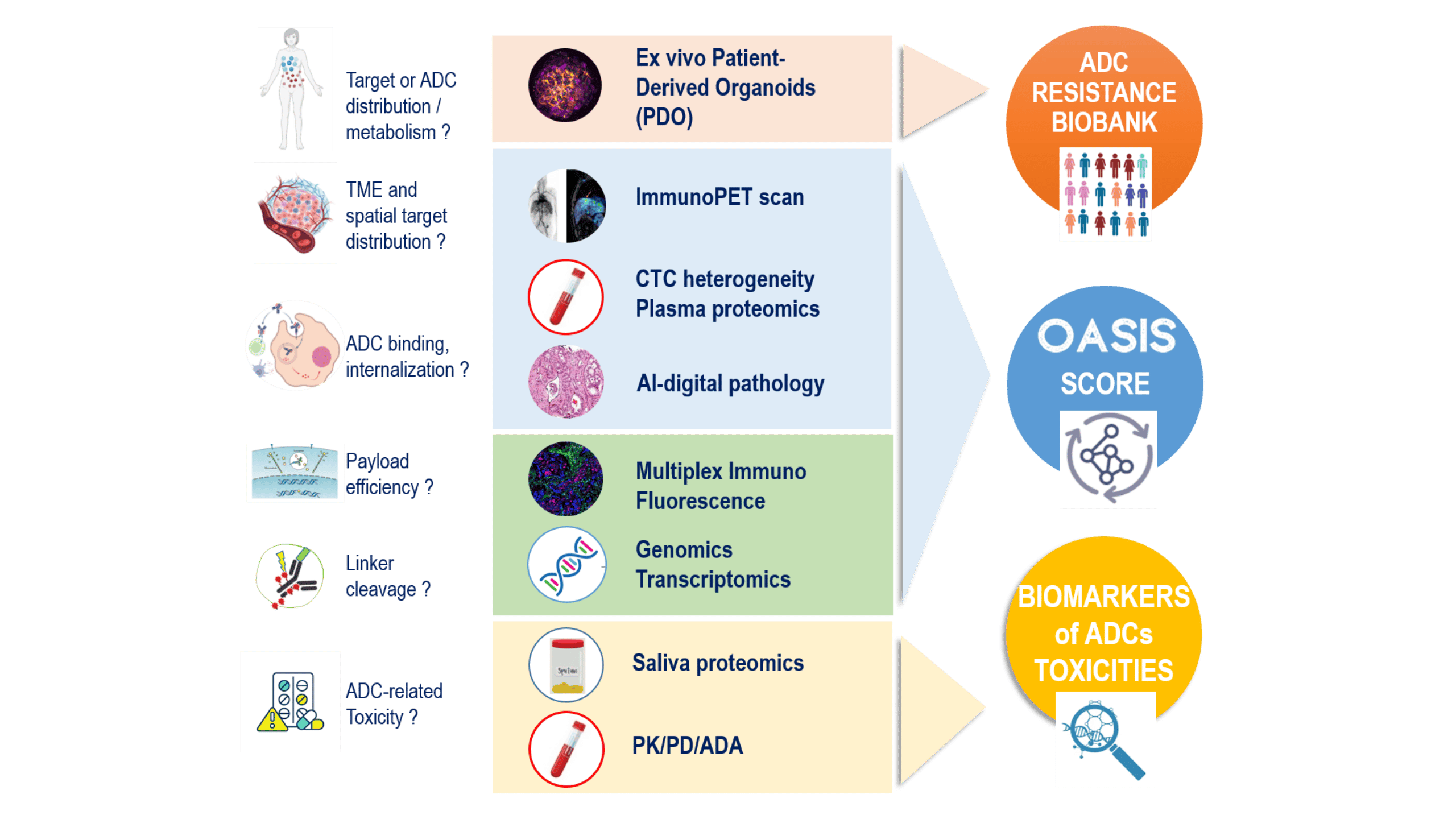
OASIS aims to better understand why ADCs work for some patients and not for others. By studying tumors, blood samples, medical imaging, and clinical data, the project seeks to identify reliable biomarkers that can predict both treatment response and toxicity.
The ultimate goal is clear: to help clinicians select the right ADC, for the right patient, at the right time — moving oncology closer to truly personalized medicine.
By combining clinical research, advanced technologies, and artificial intelligence, OASIS is laying the groundwork for smarter, safer, and more effective cancer treatments across Europe.
The clinical trial
The OASIS Clinical Trial is
already on going
We are actively recruiting patients in the OASIS clinical trial - follow the stats below !
3
Participating countries
13
Over 40 Recruiting centers
25
Over 400 patients included
The Research
OASIS technologies
Discover the innovative approaches developed as part of the OASIS project to optimize ADC therapies.
Understanding why ADCs work — or don't — is not simple. A patient's response to an antibody–drug conjugate (ADC) depends on many biological factors: target expression, drug internalization, payload release, sensitivity to the cytotoxic agent, and interactions with the tumor microenvironment. On top of this, ADCs can cause specific toxicities that are still difficult to predict. OASIS was designed to address this complexity.
European consortium
The OASIS consortium
A unique collaboration bringing together the best European experts in oncology, pharmacology and translational research to revolutionalize the ADC therapies.
The OASIS project is built on a strong and diverse European consortium that brings together 12 complementary partners from across Europe, all united by a shared ambition: improving cancer treatment through smarter use of antibody-drug conjugates (ADCs).
Launched in January 2025 and coordinated by Gustave Roussy, OASIS brings together a unique mix of:
Leading cancer centers and hospitals, ensuring direct access to patients and clinical expertise


Academic research institutions, driving innovation in biology, imaging, and artificial intelligence
Industrial partners and biotech companies, contributing cutting-edge technologies and translational know-how

Patient advocacy organizations, ensuring that patient perspectives remain central at every stage of the project
This diversity is not incidental — it is essential. Understanding ADC response and resistance requires tackling the problem from multiple angles: clinical, biological, technological, computational, and human. No single discipline or institution could address this challenge alone.
By combining expertise in clinical oncology, digital pathology, molecular imaging, proteomics, genomics, data science, and patient engagement, the OASIS consortium is able to bridge the gap between laboratory research and real-world patient care.
Discover our partners