Optimal methods to characterize ADC resistance in solid tumors and identify clinically useful biomarkers
The OASIS Project
The OASIS project, an acronym for "Optimal methods to characterize ADC resistance in solid tumors and identify clinically useful biomarkers", is a European research program focused on the optimization of antibody-drug conjugates (ADCs), a new class of cancer therapies.
These innovative treatments precisely target cancer cells, thereby reducing damage to healthy tissue. Coordinated by Gustave Roussy and led by Dr. Barbara Pistilli, the project aims to develop tools allowing clinicians to select the most appropriate ADC for each patient, based on their clinical characteristics and the biology of their tumor.
Context and Challenges
Over the past five years, ADCs have transformed cancer care, significantly improving survival rates for patients with solid and hematologic tumors. However, despite these promising results, many patients eventually develop resistance to these innovative treatments, while others experience significant side effects, such as lung inflammation, neuropathy, or skin toxicity. The OASIS program aims to address these challenges by studying the mechanisms of resistance in order to personalize the choice of ADC for each patient and prevent severe toxicities.
To achieve this, the project relies on multicenter clinical trials incorporating various cutting-edge technologies, such as novel nuclear medicine techniques, digital pathology, liquid biopsies, and organoids derived from the tumors of patients enrolled in the study. OASIS aims to support physicians in prescribing the most suitable ADC, maximizing its effectiveness while minimizing the risk of toxicity. All the data collected will also be used to develop a new generation of ADCs capable of overcoming certain resistance mechanisms. This new drug will be evaluated as part of the OASIS program.
The OASIS project aims to better understand the mechanisms that determine the efficacy and toxicity of antibody-drug conjugates (ADCs), in order to optimize their use in oncology.
Objectives
A patient’s response to an ADC depends on multiple biological factors, such as the level of target expression, cellular internalization mechanisms, linker cleavage for payload release, sensitivity to the cytotoxic agent, and interactions with the tumor microenvironment. This complexity calls for an integrated multiparametric approach.
OASIS leverages advanced molecular imaging technologies combined with preclinical and clinical platforms to simultaneously analyze the key determinants of response and resistance to ADCs. In parallel, the project seeks to better characterize the specific toxicities associated with these treatments, which can be debilitating and lead to treatment interruptions. These toxicities—often caused by off-target or off-tumor effects—are still poorly anticipated today.
All collected data will feed into the development of a multimodal predictive model based on artificial intelligence: the OASIS score. This score will estimate, based on each patient’s and each tumor’s unique characteristics, the likelihood of response to a given ADC as well as the associated risk of toxicity, with the goal of guiding therapeutic decisions as accurately as possible. The program will also help determine which of the various technologies used is most effective in predicting ADC response, with a view to developing it as a companion diagnostic test.
Methodology
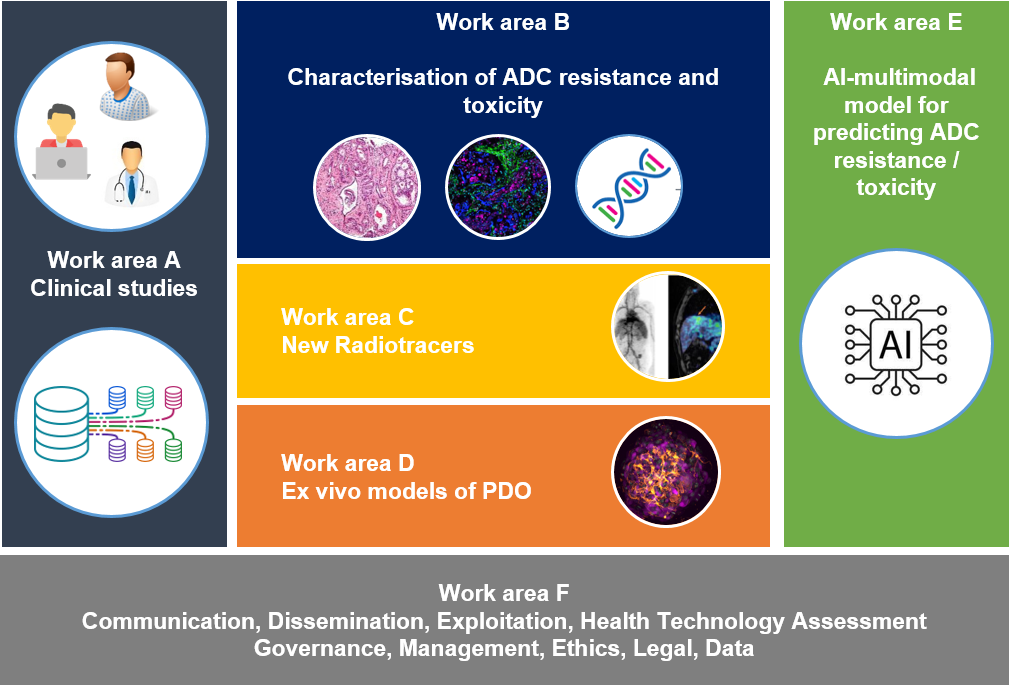
The OASIS project is based on an integrated strategy combining clinical trials, advanced biomedical technologies, and artificial intelligence. Two types of cohorts are being established:
A prospective cohort
Of 400 patients treated with ADCs across three European countries, with collection of biological samples, clinical data, and imaging.
A retrospective cohort
Based on over 500 previously collected samples, allowing for broader observations and strengthened statistical analyses.
These cohorts are enhanced by a set of high-precision analyses
High Precision Analysis

High Throughput Proteomics
Olink PEA Technology
Genomics & Transcriptomics
Mapping of molecular alterations

ImmunoPET
Visualization of therapeutic targets in vivo

Digital Pathology
Advanced tumor tissue imaging

Liquid Biopsies
Analysis of circulating tumor cells (CTC)

Tumor Organoids
Models mimicking the real tumor microenvironment
Data Integration
All this data is integrated into a predictive model based on machine learning: the OASIS Score. This score constitutes a decision-making tool for clinicians, allowing them to:
- Select the optimal ADC for each patient
- Anticipate toxicity risks
- Personalize therapeutic monitoring
The multimodal approach makes it possible to combine information of very different natures for a more robust and reliable prediction.