Artificial Intelligence Models
Combines multimodal data to predict ADC response and toxicity and guide treatment decisions.
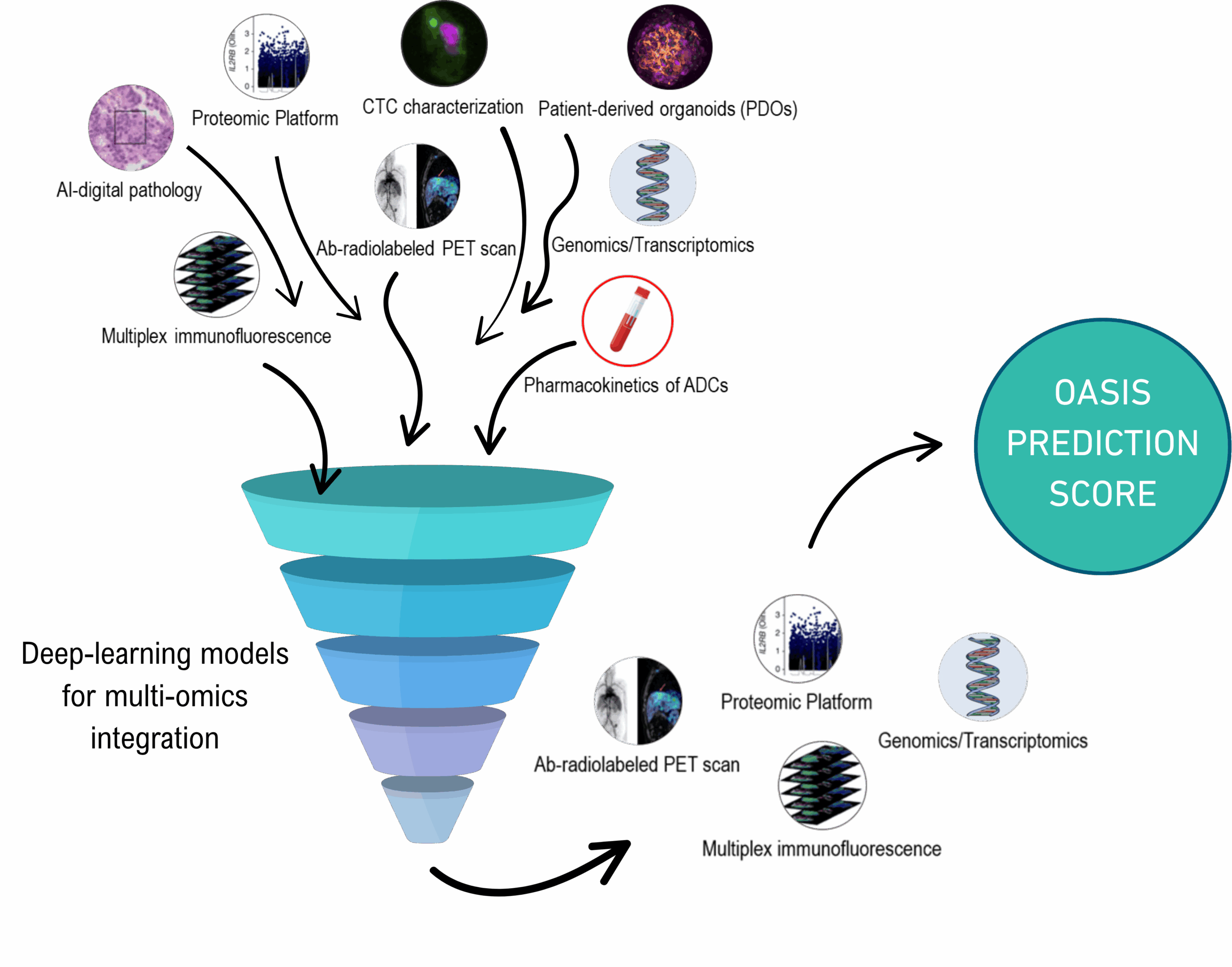
By combining all OASIS data — biological, pathological, molecular, clinical, and imaging — the OASIS project will develop an integrated predictive model: the OASIS score. This score will guide clinicians in treatment selection, enabling truly personalized use of ADCs.
Artificial Intelligence Models
A key pillar of the OASIS program is the development of advanced artificial intelligence (AI) models to integrate the large and diverse amount of data generated across the project. OASIS produces multimodal information describing the patient, the tumor, and its microenvironment, including clinical data, genomics, transcriptomics, proteomics, digital pathology, multiplex immunofluorescence, ImmunoPET, circulating tumor cells, and ctDNA.
While each data type is informative on its own, the relationships between them are complex and not fully understood. AI provides a powerful framework to identify the most relevant features, uncover hidden patterns, and combine them into predictive scores of response and toxicity to antibody–drug conjugates (ADCs).
Multimodal AI strategies and predictive modeling
OASIS will implement two complementary AI strategies. The first is a knowledge-based approach, which combines biomarkers identified independently in the different work packages into multivariate statistical and machine-learning models. These models will be used to predict treatment efficacy through survival analyses, such as progression-free and overall survival, and to estimate the risk of ADC-related toxicities using classification models.
The second is a data-driven approach, relying on deep learning to jointly integrate all data modalities. In this framework, latent representations are learned from heterogeneous data sources and combined into neural networks to predict clinical outcomes.
Both strategies will be extensively evaluated and compared through ablation studies to identify the optimal balance between prediction accuracy, robustness, and experimental cost, by retaining only the most informative data sources.
Robustness, uncertainty, and explainability
Several key challenges are addressed in the design of the OASIS AI models. First, the models must be robust to missing data and missing modalities, as not all data types will be available for every patient. Different strategies will be implemented to handle incomplete inputs.
Second, prediction uncertainty will be explicitly quantified, providing confidence intervals to support clinical decision-making and reduce the risk of incorrect predictions.
Finally, explainability is a central requirement. In healthcare, understanding why a model makes a prediction is as important as the prediction itself. OASIS will leverage state-of-the-art interpretability methods developed by CentraleSupélec to highlight the biological functions, pathways, and spatial tumor niches that drive model predictions.
By linking AI outputs to interpretable biological mechanisms, the models will help generate new hypotheses on ADC response and resistance.
Toward a clinical decision-support platform
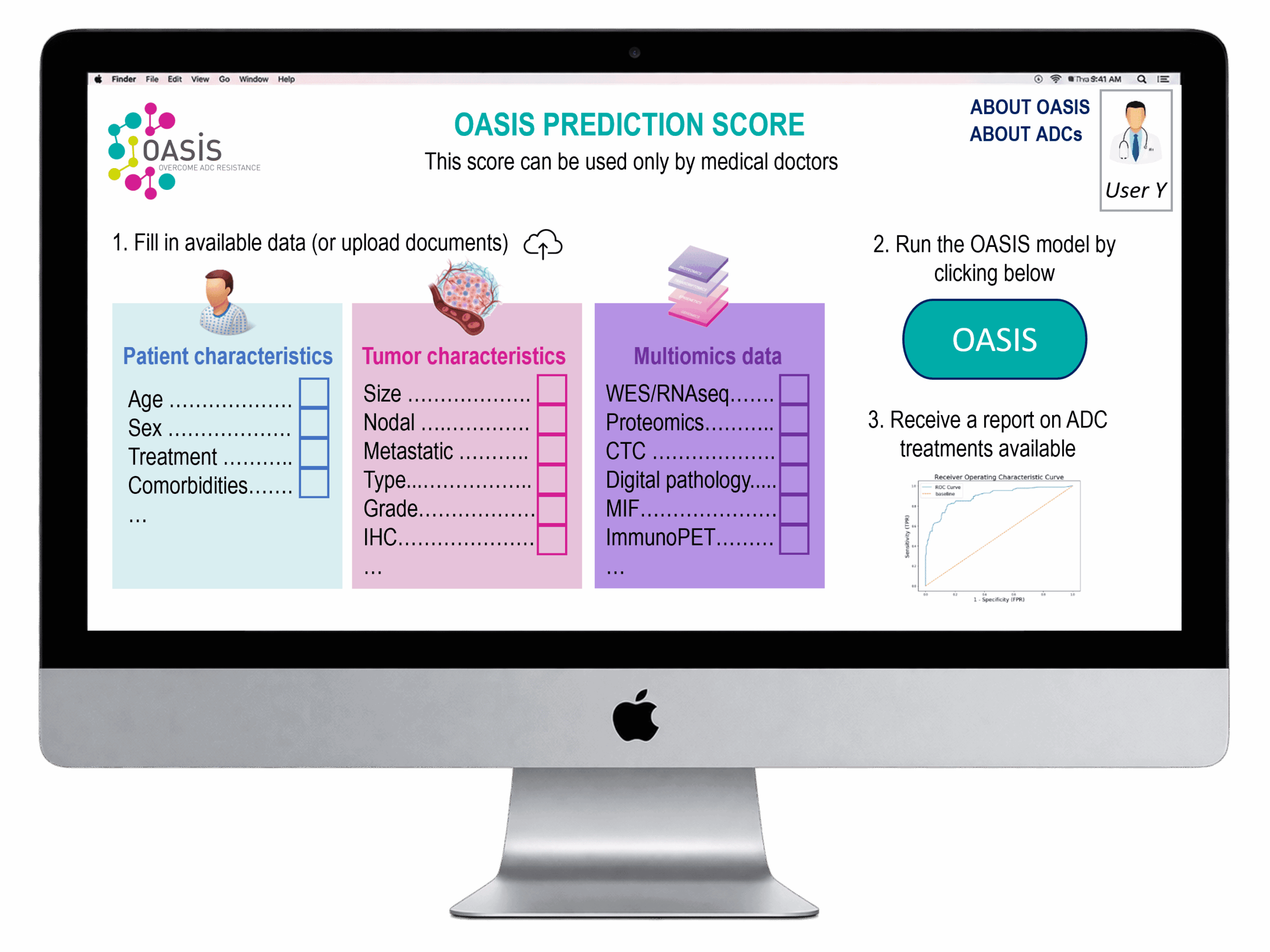
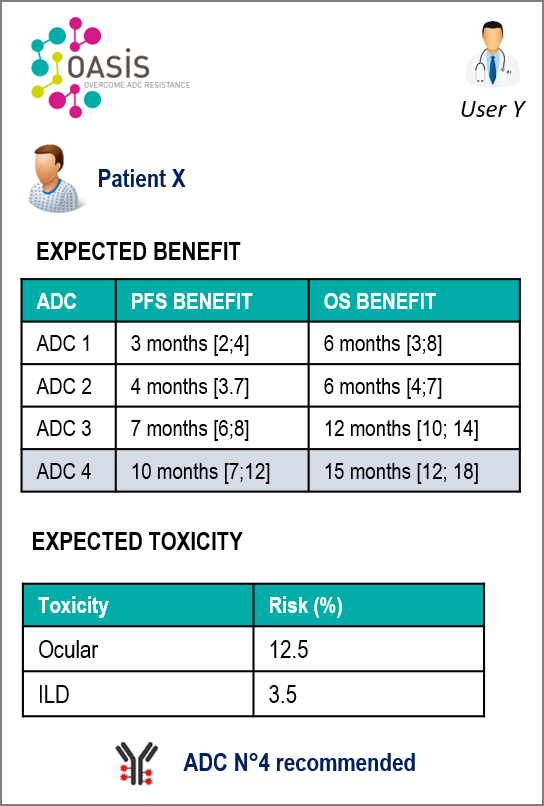
The ultimate goal of the OASIS AI work is to develop a secure web-based clinical decision-support tool. Through this platform, clinicians will be able to enter the data available for a given patient and receive a report summarizing the expected benefit and toxicity of different ADC treatments, along with uncertainty estimates and interpretability results.
The models will be trained on OASIS retrospective and prospective cohorts and validated on independent datasets.
The platform will be developed in compliance with data protection regulations, with anonymized patient data and secure storage. Over time, and with clinician agreement, new data may be used to further improve model performance.
By combining multimodal data integration, robust AI modeling, and clinical usability, OASIS aims to bring AI-driven precision oncology closer to real-world clinical practice.